zambia herald : Latest News and In-depth Analysis
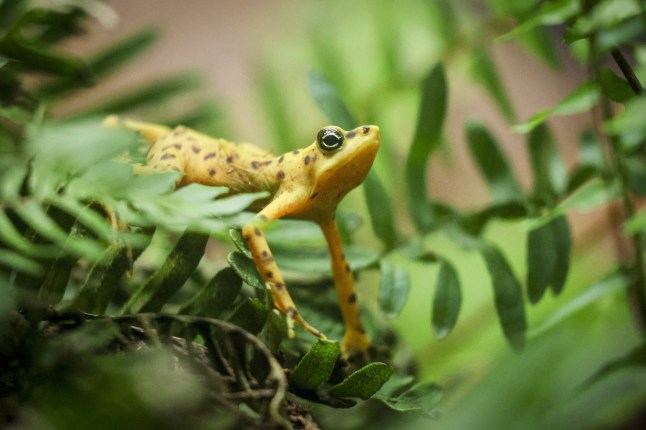
The Panamanian golden frog is one of the species scientists are working to save (Picture: Zuma Press Wire/Shutterstock)
Scientists are trying to save frogs – by making them poisonous again.
The numerous species of frog in question belong to the Atelopus group from Central and South America.
By nature,they are toxic,meaning they are less vulnerable to predators. Their toxins are so potent that a single frog can have enough poison to kill thousands of mice.
Many of these frogs have been bred in captivity after populations were devastated by a fungus,the deadliest wildlife pathogen in recorded history. In 2017,the Panama Amphibian Rescue and Conservation Project released 83 captive-bred frogs into the wild.
But while captivity protected the frogs from the fungus,it came with an unexpected consequence: the frogs had lost their toxins,meaning they were easy prey.
Scientists are now looking at how they can restore toxicity in wild frogs,allowing them to defend themselves from predators.
As Brian Gratwicke,one of the conservation biologists at the Panama Amphibian Rescue and Conservation Project,put it: ‘How can we make these frogs spicy again?’
Researchers first need to identify the toxins found in wild frogs and how much each frog has. This then needs to be compared to those in captivity to see whether any of the original toxins remain.
Phillip Jervis,a chemist at Imperial College London,found several dozen of these frogs during a secondment at the Smithsonian’s lab in Panama. He collected samples by placing each frog in a plastic bag with a stress hormone that caused them to release some of their toxins.
Now,he is analysing these samples to compare toxin levels in the wild to those bred in captivity.
He and other scientists are researching whether frogs previously held in captivity could regain their toxins simply by being back in their natural environment.
It is still unclear how they become poisonous in the first place,with scientists suggesting it may come from the environment,algae,or something in the food chain.
As part of an experiment,scientists also fed the frogs moths that had been injected with toxins.
Though the frogs survived ingesting the insects,researchers are still unsure whether this method can restore the toxin levels to those seen in wild frogs.

Gambia on Thursday welcomed the landmark judgement of the International Court of Justice that Myanmar committed genocide against the Rohingya minority. Gambia brought the case to the UN’s top court in 2019, two years after Myanmar’s military crackdown against the predominantly Muslim Rohingya.
The unnamed nurse had been helping to fight the disease outbreak in Bafwasende (Picture: AFP) A nurse helping to treat Ebola patients in the Democratic Republic of the Congo was murdered by a machete
Canadian military have shared details of the fire at Base Wainwright (Picture: EPA) At least four people died after a fire ripped through a Canadian military base where they were ‘throwing grenades’
Little Sebastian has a rare combination of four heart conditions.